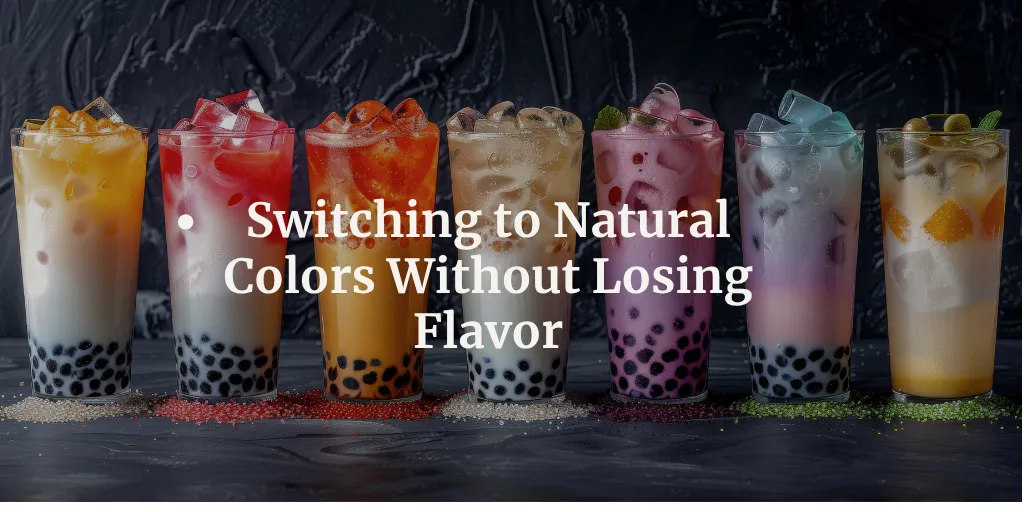
Switching to Natural Colors Without Losing Flavor
Switching to Natural Colors? Here's What It Does to Your Flavor (and How to Fix It)
Say you've got a strawberry ready-to-drink tea that's been colored with Red 40 for years. You decide it's time to switch to natural colors, so you pull a carrot-based anthocyanin and match the shade on the bench. It looks perfect. Side by side, you honestly can't tell them apart.
Then you run a quick taste panel, and three out of five people say the new one tastes "less strawberry." Same flavor. Same sugar. Same acid. Different color source.
That gap between how a drink looks and how it tastes is the part of switching to natural colors that almost nobody writes about. There's plenty out there on pH, heat, and light stability, and we'll get to all of it. But if you're a product developer, the question you actually have to answer is simpler: will people still love this thing after the swap? Let me walk you through what's happening on the regulatory side, what each natural color family does in a beverage, and how to keep your flavor intact while you make the change.
Where the Synthetic Dye Phase-Out Actually Stands Right Now
The "no artificial colors" labeling change
Beetroot red and spirulina, approved and then paused
Why Natural Colors Aren't a Drop-In Replacement
Color Changes How Your Product Tastes
Color tells the tongue what to expect
Some colors bring their own flavor
Fading color reads as stale flavor
A Color-by-Color Field Guide to Natural Colors in Beverages
Reds, pinks, and purples from anthocyanins
Yellows and oranges from carotenes
Turmeric yellows from curcumin
Blues and greens from spirulina
Blues and purples from jagua (genipin)
Color Combinations That Work Against Each Other
Matching Your Flavor to Your New Color
A Step-by-Step Plan for Switching to Natural Colors
Is the FDA requiring companies to remove artificial dyes?
Can I label my product "no artificial colors" if I use natural colors?
Do natural colors change the taste of a product?
What's the most stable natural blue for beverages?
Can natural colors be used in alcoholic beverages?
How much more natural color will I need when switching to natural colors?
Where the Synthetic Dye Phase-Out Actually Stands Right Now
Things have moved fast since spring 2025, and a lot of what's floating around online is already out of date. Here's the short version as of fall 2026.
The federal picture
The big headline was the FDA and HHS asking companies to drop six petroleum-based dyes (Red 40, Yellow 5, Yellow 6, Blue 1, Blue 2, and Green 3). The original target was the end of 2026. That goal has since moved to the end of 2027. The phase-out also rests on an understanding between the FDA and manufacturers, with no formal agreement published and no completed rulemaking. So it’s voluntary. That said, plenty of large brands have already committed, and retailers are asking suppliers where they stand.
Two dyes have actually lost their approval. Red 3 is banned from food effective January 15, 2027. Orange B was formally revoked in 2026. It was only ever approved for hot dog and sausage casings, and nobody had certified a batch since 1978, so it won’t show up in your beverage portfolio. FDA has also proposed revoking Citrus Red No. 2, the dye used on orange peels. If Red 3 is anywhere in your lineup, that January date is the real one.
The "no artificial colors" labeling change
This one matters for marketing teams. Under a policy the FDA announced on February 5, 2026, companies can now say a product contains "no artificial colors" as long as it has no petroleum-based synthetic dyes, even if it uses FDA-approved colors from natural sources. Before this, the claim was a lot murkier. Now, finishing a clean natural color swap gives you a label claim you can actually use.
Beetroot red and spirulina, approved and then paused
Here's where it gets messy. FDA issued final orders on February 6, 2026, approving beetroot red and expanding the approved uses of spirulina extract, then delayed the effective date on March 20 while it evaluates objections. The objections were interesting. One group argued beetroot red doesn't qualify as "natural" because it's produced with synthetic biology. Spirulina extract is still an approved color. It's the expanded uses that are on hold. Check FDA's color additive page before you build a launch plan around either one.
The state patchwork
States jumped in too, but the courts slowed them down. West Virginia's statewide ban and Texas's warning-label requirement have both been preliminarily blocked, and both cases are on appeal. School meals are a different story. Virginia's ban on seven dyes in school meals took effect July 1, 2026, and California's ban on six dyes takes effect December 31, 2027.
School meals are a different story. Virginia’s ban on seven dyes in school meals takes effect July 1, 2027, and California’s ban on six dyes follows on December 31, 2027.
Why Natural Colors Aren't a Drop-In Replacement
If you're replacing artificial food dyes for the first time, the first surprise is usually volume. Synthetic dyes are incredibly concentrated. Natural pigments aren't. Industry guidance puts it anywhere from four to 12 times more material than synthetic color, and some estimates run far higher for tough shades. The exact number depends on the shade and the application, but either way it affects cost, and it can affect taste. More on that in a minute.
The second surprise is that natural colors react to their surroundings. Some shift shade with pH. Some fade in clear bottles under store lights. Some can't handle pasteurization. Some drop out of solution and leave a ring at the neck of the bottle. And a couple of them flat-out don't get along with each other.
None of this means natural colors don't work. They clearly do. Nestlé moved more than 20 of its Vitality beverage products to natural colors in about five months, by its own account without hurting quality or taste. It just means you have to pick the right color for your base, your process, and your packaging, instead of grabbing whatever red is on the shelf. For refrence, check out our blog, Natural vs. Artificial Flavors: What Food and Beverage Manufacturers Need to Know.
Color Changes How Your Product Tastes
This is the section I wish more people read before they start benching. There are three separate things going on, and they compound.
Color tells the tongue what to expect
People taste with their eyes first. Red suggests berry or cherry, yellow tends to cue lemon, and green reads as lime or mint. That expectation shapes what they actually perceive once the drink hits their palate.
So when your new natural red lands a little more purple, or a little more orange, than the old Red 40, your brain reads a slightly different fruit. Nothing about the flavor changed. The cue did. That's what's usually happening in our strawberry tea example. The shade drifted just enough toward raspberry or cherry that the strawberry reads weaker.
Some colors bring their own flavor
Natural colors come from plants, algae, and roots, and some of them taste like where they came from. Beet, paprika, and some anthocyanins can bring earthy, bitter, vegetal, or astringent natural color off-notes. Turmeric and beet both carry earthiness, paprika adds a slight pepper character, and spirulina has a marine note.
At low use levels in a bold flavor, you'll probably never notice. But remember that natural colors need higher use levels. In a light base like a flavored water or a white peach seltzer, those notes can show up fast.
Fading color reads as stale flavor
Here's the sneaky one. If your color fades on the shelf over eight weeks, the drink looks older. And when a drink looks older, people tend to report that it tastes flatter, even if the flavor chemistry is exactly where it was on day one. Color stability is a flavor problem as much as a visual one.
A Color-by-Color Field Guide to Natural Colors in Beverages
This is the practical part. Our team has spent a lot of time benching natural colors in beverages, and these are the notes we keep coming back to. For each color family, you'll find where it comes from, what it tolerates, what to watch out for, and which flavors it plays nicely with.
Reds, pinks, and purples from anthocyanins
Anthocyanins come from black carrots, purple sweet potatoes, blueberries, radishes, and black currants. They're the workhorse for reds, pinks, bordeaux, and violets.
The thing to know about anthocyanins is that they're pH sensitive. At low pH, the red leans warmer and more yellow-toned. As you move toward neutral, it shifts blue. They're most stable below pH 3.5, which is great news for most acidic beverages. They also hold up to HTST pasteurization (roughly 95 °C for 15 seconds), and they work best in drinks under about 20% ABV. A good starting use level is around 0.04%.
Two watch-outs. First, anthocyanins degrade faster in the presence of ascorbic acid, so if your formula leans on vitamin C, test carefully. Second, they can be light sensitive at very low use levels, which matters for clear bottles.
Flavor fit: Berry, cherry, grape, pomegranate, hibiscus, and black currant all feel natural here. At higher use levels, some sources can bring a slightly vegetal or astringent edge, so a bright berry top note helps.
Beet reds from betanin
Betanin comes from beets and gives you a strong pink to red that doesn't shift with pH. It's stable from about pH 3 to 8 and can be helped along with small amounts of ascorbic acid (under 0.05%), citric acid, or EDTA at around 40 ppm.
The catch is heat and light. Betanin doesn't survive HTST, and it fades under light. We don't recommend it for ready-to-drink beverages. But in ready-to-mix drink powders, where there's no heat step and the product lives in an opaque pouch, it's a great option.
Flavor fit: Beet is earthy. That's the geosmin talking. Raspberry, cherry, ginger, and chocolate all work with that earthiness instead of fighting it. A little citrus brightness helps too.
Yellows and oranges from carotenes
Carotenes come from carrots, peppers, and algae. They don't shift with pH, which makes life easier, and they hold up well to heat and light when you add ascorbic acid at around 300 ppm in the finished beverage. Start around 0.02%, and they work in drinks up to about 30% ABV.
Their weak spot is that they're cloudy, and in RTDs they tend to settle or leave a ring at the neck of the bottle. The fix we've had success with: mix gum acacia (gum arabic) with the color at a 1:1 ratio and homogenize, then add xanthan gum and mix until uniform. The gum acacia prevents ringing, and the xanthan keeps everything suspended. Some suppliers also sell pre-stabilized algal carotenes that skip this step.
Flavor fit: Citrus, mango, peach, apricot, and passion fruit. If your carotene comes from paprika, watch for a faint pepper note in lighter flavors.
Turmeric yellows from curcumin
Turmeric gives a bright, warm yellow. It isn't pH sensitive and it handles heat well. Light is the problem. Curcumin fades under light, so in RTDs it really only makes sense in opaque packaging. In drink powders, it's excellent.
Flavor fit: Turmeric tastes like turmeric, earthy and a little bitter. Lean into it with ginger, lemon, pineapple, chai spices, or a golden milk profile. Don't try to hide it in a delicate lemonade.
Cochineal and carmine
Cochineal comes from insects. It's pH dependent, shifting from orange toward red as the pH goes up, and it has great heat and light stability with no additives. It can run slightly cloudy and may precipitate below pH 3.5.
The big consideration here isn't technical. Carmine isn't kosher, and it isn't vegan. If either of those claims matters to your brand, cochineal is off the table.
Flavor fit: Pretty neutral at typical use levels, which is part of why it's been used for so long.
Blues and greens from spirulina
Spirulina is still the go-to natural blue. It gives a bright, clean blue that's hard to match any other way. But it's fussy. It's happiest around pH 7, and it's sensitive to both heat and acid, which is tough in a category where most drinks are acidic.
The biggest process tip we can give: add the blue color first and make sure it's completely mixed before you add acid or flavor. Order of addition makes a real difference. Cut heat and hold times wherever your food safety plan allows. Some color suppliers also offer stabilized spirulina systems for RTDs using additives like carrageenan and EDTA. Start around 0.05%.
Flavor fit: Spirulina can carry a slightly marine, grassy note. Mint, lime, coconut, and tropical profiles cover it well, and that's why so many naturally colored blue drinks taste like one of those four.
Blues and purples from jagua (genipin)
Jagua, also called huito, is a fruit whose clear juice turns blue when it reacts with amino acids. It's generally more stable than spirulina and gives a dark purple-blue that can look a little muddy on its own.
It does best in neutral or alkaline conditions and isn't stable below pH 5, especially with heat or light. It's also sensitive to ascorbic acid, though EDTA may help. For acidic RTDs, that's a real limitation. For dairy, plant milks, or neutral-pH drinks, it's worth a look. Color suppliers are clearly betting on it, with liquid jagua blues hitting the market this year.
Flavor fit: Blueberry, blackberry, and grape feel right with jagua's deeper shade.
The newer options
The palette is growing. Four natural colors won FDA approval in 2025: Galdieria extract blue, expanded uses for butterfly pea flower extract, calcium phosphate (white), and gardenia (genipin) blue.
Galdieria blue is the one to watch for acidic beverages, since it's a phycocyanin blue built to handle lower pH than spirulina. Europe's food safety authority gave it a positive safety opinion in March 2026, so it's moving forward there too. Butterfly pea flower shifts from blue to purple as you add acid, which some brands use on purpose for color-changing drinks. And calcium phosphate gives you a natural white, which is handy for opaque or creamy looks.
These are still early. Supply is tighter, pricing is higher, and there's less real-world shelf-life data. We'd treat them as options to test, not your default.
The quick-reference table
Color source | Shades | Watch out for | Flavor note | Flavors that pair well |
|---|---|---|---|---|
Anthocyanins | Red, pink, purple | pH shifts, ascorbic acid, light at low use | Occasional astringent edge | Berry, cherry, grape, hibiscus |
Betanin (beet) | Pink, red | Heat (no HTST), light | Earthy | Raspberry, cherry, ginger, chocolate |
Carotenes | Yellow, orange | Cloudiness, ringing | Mild; peppery if paprika | Citrus, mango, peach |
Curcumin (turmeric) | Yellow | Light | Earthy, slightly bitter | Ginger, lemon, pineapple, chai |
Cochineal | Orange to red | Not kosher or vegan | Neutral | Almost anything |
Spirulina | Blue, green | Heat, acid | Marine, grassy | Mint, lime, coconut, tropical |
Jagua | Dark blue, purple | Below pH 5, ascorbic acid | Low | Blueberry, blackberry, grape |
Color Combinations That Work Against Each Other
Here's something that trips up a lot of people. You'd think you could make orange by mixing a natural red and a natural yellow, the way you can with synthetic dyes. Sometimes you can't.
Anthocyanins and carotenes are often incompatible when mixed. On top of that, they want opposite things. Carotenes like ascorbic acid, since it's what keeps them stable. Anthocyanins break down faster with ascorbic acid around. Put them in the same bottle and you can end up protecting one color while slowly destroying the other.
So if you need an orange, start with a carotene-based orange instead of trying to build one. If you do have to blend, bench it with your full formula, including any vitamin C, and run it through a real shelf-life test before you commit.
Greens have a similar story. A spirulina blue plus a carotene yellow can make a nice green, but the blue is usually the weak link. It'll fade first, and your green will drift toward yellow over time. Plan your color target with that drift in mind.
Matching Your Flavor to Your New Color
Once you've picked a color, the flavor work starts. And yes, you may need to adjust a flavor you haven't touched in years.
Start by deciding whether you're going to work with the color's natural character or around it. Working with it is usually easier. If you're using beet, a raspberry or cherry profile will absorb that earthiness instead of fighting it. If you're using spirulina, mint or lime covers the marine note so well that nobody notices.
When you can't change the flavor direction, because it's a legacy SKU and people expect it to taste exactly the same, masking and modulating flavors are your tools. The goal is to take out the off-note without changing the flavor people know. This is where a small tweak to the top notes can make a big difference, like brightening a strawberry so it reads as strawberry again, even with a slightly cooler red behind it.
Two more things we'd push hard on.
Don't chase a perfect color match. Natural colors almost never land exactly on Red 40 or Blue 1, and trying to force it usually means cranking up use levels, which brings more off-notes and more cost. Consumers seem more forgiving than developers expect. ADM found that 61% of US confectionery consumers are willing to accept some change in appearance as a reformulation tradeoff. Get close, then make sure the flavor matches the shade you actually have.
Don't test in water. A color and flavor that look and taste great in a water base can act completely differently in your real product. Acid, sugar, alcohol, carbonation, protein, and fat all change how both color and flavor behave. Always bench in the thing you're actually going to sell.
A Step-by-Step Plan for Switching to Natural Colors
If you're about to start switching to natural colors across a product line, here's the order we'd tackle it in.
Audit your SKUs. List every product with a synthetic dye, which dye it uses, and where it sells. Anything with Red 3, or anything going into schools, goes to the top of the list.
Document the conditions. For each product, write down the pH, heat process (HTST, hot fill, none), ABV if it applies, and packaging (clear, tinted, opaque). These four things decide which natural colors are even possible.
Pick your color family. Use the field guide above to narrow it down. If something needs a bright blue in an acidic, clear bottle, know going in that it's your hardest project and give it the most time.
Bench in your real base. Not water. The full formula, with the real flavor, acid, sweetener, and any vitamins.
Run side-by-side sensory. Taste the new version against the current one, blind if you can. Ask whether it tastes the same, not just whether it looks the same.
Adjust the flavor. Brighten top notes, add masking where you need it, or shift the flavor direction to fit the new color.
Shelf test under real light. Store samples in your actual packaging under store-style lighting, and check both color and flavor over time.
Update your label. Once you're petroleum-dye free, look at whether the "no artificial colors" claim makes sense for you, and loop in your regulatory team.
Frequently Asked Questions
Is the FDA requiring companies to remove artificial dyes?
Mostly no, at least not yet. The six-dye phase-out is voluntary and based on an understanding with industry, not a regulation, and the target is now the end of 2027. The exceptions are Red 3, which has a firm January 15, 2027, deadline for food, and Orange B, which FDA revoked in 2026. Some states have their own rules, especially for school meals.
Can I label my product "no artificial colors" if I use natural colors?
Under the FDA's February 2026 policy, you can generally make that claim as long as the product contains no petroleum-based synthetic dyes, even if it uses approved colors from natural sources. Have your regulatory team confirm it for your specific product and market.
Do natural colors change the taste of a product?
They can, in two ways. Some colors bring their own flavor notes, like the earthiness in beet and turmeric or the marine note in spirulina. And any shift in shade changes what people expect to taste. Both are fixable with the right color choice and some flavor adjustment.
What's the most stable natural blue for beverages?
Spirulina is the most established, but it struggles with heat and acid. Jagua is generally more stable, but it needs a pH above 5. Galdieria blue is newer and built to handle acidic conditions better. For most acidic RTDs today, a stabilized spirulina system with careful order of addition is still the practical starting point.
Can natural colors be used in alcoholic beverages?
Yes, with limits. In our bench work, anthocyanins perform best under about 20% ABV and carotenes under about 30% ABV. Above that, stability drops off, so higher-proof products need extra testing.
Is carmine kosher or vegan?
No. Carmine and cochineal come from insects, so they don't work for kosher or vegan claims.
How much more natural color will I need when switching to natural colors?
Plan for several times more. Estimates run from about four times to well over ten times the synthetic volume, depending on the shade and application. That affects cost and can bring more flavor impact, so factor both in early.
Develop Color and Flavor Together
The companies that have the smoothest time switching to natural colors are the ones that stop treating color and flavor as two separate projects. The color changes the flavor. The flavor has to match the color. When one team picks a red and another team gets handed the result, you end up with a strawberry that tastes like it's missing something.
We've been working on flavor since 1912, and we carry natural reds, pinks, bordeaux, violets, yellows, oranges, and blues. So when we bench a color swap, we're tasting it at the same time. If you've got a product you're getting ready to convert, or one you already converted that doesn't taste quite right, we'd love to take a look.
[Request a Natural Color Sample] [Talk to Our Flavor Team]
